
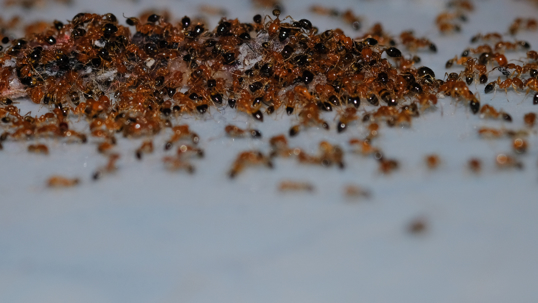
If you’ve noticed a trail of small, uniform brown ants marching across your kitchen counter, bathroom floor, or baseboard in the last few weeks, you’re not alone - and you’re almost certainly dealing with Argentine ants. July and August are peak invasion months across Walnut Creek, Concord, Danville, and the wider East Bay, driven by the same hot dry conditions that push every living thing toward water and shelter.
The frustrating part: most homeowners’ first instinct - spraying the trail - makes the problem significantly worse. Here’s what’s actually going on, and what works.
Why Argentine Ants Invade East Bay Homes in Summer
Argentine ants (Linepithema humile) are the dominant ant species throughout California, and they’ve been established across the Bay Area for over a century. A peer-reviewed study of households in Silicon Valley found that Argentine ants invaded virtually every home at the same two times of year: peak summer, when it’s hot and dry outside, and mid-winter, when it’s cold and wet. The pattern repeats reliably across the Bay Area every year.
In the East Bay’s inland climate - which runs hotter and drier in summer than coastal areas - the summer invasion window is particularly intense. When temperatures climb and soil moisture drops, Argentine ant colonies that have been living happily in your garden and landscaping lose their preferred conditions and start exploring inside. They’re not coming in because your kitchen is dirty. They’re coming in because outside is hostile and inside has water.
What makes Argentine ants uniquely difficult is their colony structure. Unlike most ant species that have a single queen and compete with neighboring colonies, Argentine ant colonies have multiple queens and cooperate with each other. The “colony” in your neighborhood isn’t just under your yard - it may extend across several properties and hundreds of feet in every direction. You’re not dealing with one nest. You’re dealing with a supercolony.
The Most Common Mistake: Spraying the Trail
When you see a trail of ants and spray it with a contact pesticide, here’s what happens:
- The ants in the trail die - that part works.
- The pheromone trail they were following is disrupted - also good, briefly.
- The surviving ants in the colony, sensing the disruption, split into multiple smaller groups and begin exploring new routes into your home.
- Within 24-48 hours, you now have ants in three locations instead of one.
This is called “budding” - a fragmented colony response that makes Argentine ants more persistent, not less, when treated with contact sprays. It’s why the same homeowner sprays the trail every day for a week and still has ants.
The correct first step when you see a trail is to wipe it with soapy water (which removes the pheromone marker without triggering a split response) and then find where the trail is entering - not what it’s heading toward.
How to Find Where They’re Getting In
Argentine ants enter through tiny gaps - a crack at a window frame, a gap where a pipe enters the wall, a gap under a door threshold, or a space where a countertop meets the backsplash. Trace the trail backward, away from the food source, toward the entry point. Common places to check:
- Under the kitchen sink, where plumbing enters the wall
- Behind the refrigerator or dishwasher where water lines come through
- Along the baseboard where it meets the floor, especially near exterior walls
- Around window frames on the ground floor
- At the gap between countertop and wall on an exterior wall
Once you find the entry point, sealing it with caulk removes that specific route. This helps, but won’t eliminate the infestation - Argentine ants will find another entry point within days if the colony is still present outside.
What Actually Works: Treating the Colony, Not the Trail
Effective Argentine ant control requires getting bait to the queen - or more accurately, to the multiple queens that sustain the colony. The approach that works:
Slow-acting gel bait at the trail: Worker ants pick up bait and carry it back to the colony. The bait needs to be slow-acting enough that workers return to the colony before dying - fast-acting sprays and baits kill the workers before they can share the bait with the queens. This is why the bait you use matters as much as where you put it.
Exterior bait stations: Placing bait stations along the perimeter of the home, at the foundation, and near ant activity zones outside treats the colony at the source - where they live, not just where they’re foraging inside.
Entry point exclusion: Professional treatment combined with caulking and sealing the most common entry points creates a lasting result rather than a temporary interruption.
The honest truth about Argentine ants: you’ll never fully eliminate a supercolony that spans your neighborhood. The goal of treatment is to reduce pressure to the point where they stay outside. When conditions improve for them outdoors - which happens naturally in the fall when temperatures drop and moisture returns - they stop trying to come in on their own.
How Long Does it Take for Ant Control to Work?
With professional slow-acting bait treatment, most homeowners see a significant reduction in ant activity within 3-7 days. Full results typically take 2-3 weeks as the bait works its way through the colony. This is slower than a contact spray but produces lasting results rather than a fragmented colony that returns in two days through a different entry point.
If ant activity hasn’t significantly reduced after two weeks of professional treatment, it usually means there’s an entry point that wasn’t found or a secondary colony source that needs to be identified.
We provide ant control throughout Walnut Creek, Concord, Danville, Lafayette, Pleasant Hill, and the wider East Bay. We use IPM methods that target the colony rather than just the visible trail.
Frequently Asked Questions
Why do I suddenly have ants in my house in summer when I didn’t have them before?
Hot, dry East Bay summers reduce soil moisture and make outdoor conditions hostile for Argentine ant colonies. July and August are the peak invasion months across Contra Costa County as colonies push indoors seeking water and cool conditions. The same pattern repeats every summer - ants typically retreat outside on their own once fall rains begin and outdoor conditions improve. Professional treatment makes that transition happen faster and keeps pressure lower throughout the summer.
Will ants go away on their own?
Eventually, yes - the study of Silicon Valley households found ants left when outdoor conditions improved, regardless of what homeowners did inside. But “eventually” in an East Bay summer can mean September or October. Professional treatment significantly reduces the invasion in the near term.
Is it safe to use ant bait if I have pets or small children?
The gel baits used in professional ant treatment are formulated at very low concentrations and placed in locations inaccessible to pets and children. They’re significantly safer than broadcast contact sprays. We’ll discuss placement and any precautions specific to your home before treating.
I’ve tried every product at the hardware store. Why won’t they go away?
Most over-the-counter ant products are contact killers that disrupt the trail and trigger colony splitting. They kill the ants you see but cause the surviving colony to spread into multiple new entry points. Effective Argentine ant control requires slow-acting bait that workers carry back to the colony, not fast-acting sprays that kill before they can.
How much does ant control cost in the East Bay?
A one-time ant treatment is typically straightforward and affordable. For homes with recurring summer ant pressure, an ongoing perimeter treatment plan is more cost-effective than annual one-time treatments. Call (925) 204-2455 for a free estimate.
Still seeing ants after repeated DIY attempts? Call Mighty Men at (925) 204-2455 - we serve Walnut Creek, Danville, Concord, and the wider East Bay.